
The falsely obvious

1.
Ray set down the bread plate. He was in his seventies, with big ears, fuzzy hair, the wide grin of an elf. Earlier he was cracking jokes about his uselessness in retirement, about creaking like a floorboard after hip surgery. He was not laughing now. He stared at me. His mouth was a thin line.
“What are you—a socialist?”
The word sliced through the room. It was 2019. Ray and I were dinner guests. In the news, pundits were outraged over the Green New Deal. Conservatives called it a “socialist nightmare,” “socialism on steroids,” a “radical, top-down, socialist makeover of the entire U.S. economy.”
Ray’s butter knife waved in my direction. “Don’t tell me you support socialism. Do you want to hand our freedoms to the government? Do you want us to end up like Cuba?”
Did Ray know what socialism was? Did I? A glob of sweet potatoes cooled at the end of my fork. What were we arguing about?
2.
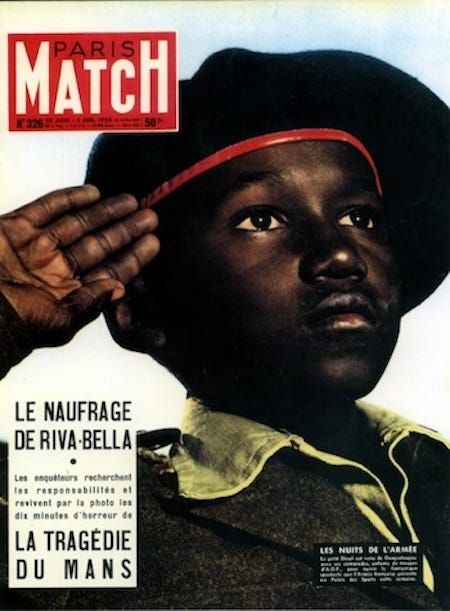
Paris, 1955. A man picks up Paris Match in a barbershop and pauses at the cover: a young Black boy in the French uniform, chin lifted, saluting. “I see very well what it signifies to me,” wrote Roland Barthes, “that France is a great Empire—that all her sons, without color discrimination, faithfully serve under her flag.”
As a critic of popular culture, Barthes sought to interrogate the “the falsely obvious,” to uncover the concealed detritus from the texts and images of mass-produced culture. He distinguished between denotation—the literal object—and connotation, the ever-shifting web of associations and insinuations around it. For Barthes, connotation was the level where mythologies lived. The magazine cover did more than depict a boy in uniform; it cast French imperialism as noble and benevolent at a time of political urgency amid the empire’s overlapping crises in Algeria and Vietnam. “Myth has a double function,” Barthes wrote. “It makes us understand something, and then imposes it on us.” We see the boy soldier and forget to ask why he is in uniform.
3.
A friend of mine volunteered for the mayoral campaign of Zohran Mamdani, who drew widespread outcry and confusion for his membership in the Democratic Socialists of America. Far from a radical takeover of the economy, European observers noted that Mamdani’s key campaign pledges—free bus service, universal childcare, rent freezes—were basic provisions taken for granted in their home countries.
A week before the election, my friend appeared in a campaign video. Online, Mumdani’s opponents flooded the comments. Countless attacked him for being a socialist, a “commie,” a Muslim threat linked to 9/11. One person posted a fake TIME cover: Mamdani adjusting his necktie with one hand, cradling the Statue of Liberty’s bloodied head in the other. AI-generated art amplified the assault. I saw a GIF of Mumdani with a glass pitcher, emblazoned by the hammer and sickle, pouring red liquid into a cup held by Alexandria Ocasio-Cortez. Another showed Mumdani grinning widely as his shoulders are wrapped under the arms of Karl Marx. Marx turns to the viewer and laughs: “Can you believe they are falling for this?”
We are all operators today in the media machine. Denotations have become louder, cruder, crueler. Connotations are less like scalpels, more like bludgeons. Swept into the rush of commodified, one-click myth-making, who still has time for meaning-making?
“Myth abolishes the complexity of human acts,” Barthes wrote. “It organizes a world which is without contradictions because it is without depth.” 🎨
I hadn't really considered that exceptional communication might be for the purpose of making complex things more apparent in their complexity, and therefore more challenging to understand rather than easy to understand. Anyone committed to that end is automatically going to have fewer readers than the one who is willing to construct a one-dimensional myth. Thank you for making me think and for your demonstration of skill as a writer.
"Swept into the rush of commodified, one-click myth-making, who still has time for meaning-making? 'Myth abolishes the complexity of human acts,' Barthes wrote. 'It organizes a world which is without contradictions because it is without depth.'"
…i used to love fiction…now i live it…